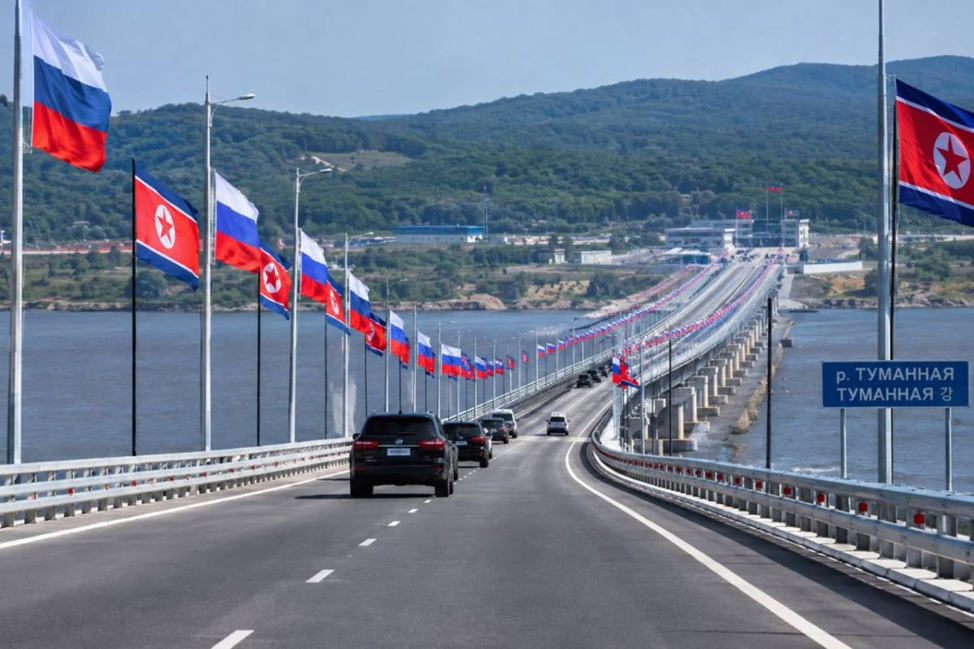
A landmark event took place on the border between Russia and the Democratic People's Republic of Korea — the opening of the first automobile bridge across the border Tumannaya River in the history of bilateral relations. The start of traffic was given via videoconference by Prime Minister of the Russian Federation Mikhail Mishustin and Chairman of the Cabinet of Ministers of the DPRK Pak Thae-song. The bridge has been named after Yakov Novichenko — an officer of the Red Army and Hero of Labour of the DPRK, who in 1946 saved the life of Kim Il-sung by shielding him from a grenade with his own body.
Technical Specifications and Construction Timeline
The total length of the bridge crossing, including access roads, is 4.7 km, with the two-lane bridge itself measuring 1 km in length and 7 meters in width. The Russian section spans 424 meters, while the Korean section is 581 meters long. The construction was carried out by the Sochi-based company TonnelYugStroy. Work commenced on April 30, 2025, and was completed in just 16 months — a record-breaking timeframe. The intergovernmental agreement on the construction was signed in 2024 in the presence of President of the Russian Federation Vladimir Putin and Chairman of the State Affairs of the DPRK Kim Jong-un.
Russian Minister of Transport Andrey Nikitin described the project as "a unique example of joint technological cooperation, joint design and construction." Throughout the process, the parties coordinated technical solutions and ensured the synchronized launching of the bridge span.
New Border Crossing and Future Prospects
Concurrently with the bridge, the automobile border crossing point "Khasan" has been erected. At its initial stage, it will be able to handle up to 100 vehicles per day in both directions, and upon reaching full capacity, its throughput will increase to 300 vehicles and over 2,500 people per day. The access road leads to the federal highway "Ussuri" — part of the international transport corridor "West–East" stretching from Saint Petersburg to Vladivostok.
Economic and Tourism Potential
The new logistics facility is expected to generate up to 10 billion rubles in annual revenue for the Russian budget through increased trade turnover. Mikhail Mishustin emphasized that the expansion of cross-border infrastructure would give a powerful boost to trade, economic, scientific, technological, and cultural cooperation between the two countries.
The Russian Union of Tourism Industry noted that the bridge creates additional opportunities for growing tourist exchanges. The launch of bus routes is planned as early as 2027. Demand for trips to the DPRK this year has increased by 10–15% compared to the previous year.
Strategic Significance
Prior to the bridge's opening, there was no automobile connection between the countries — only a railway crossing was in operation. The new bridge not only strengthens bilateral ties but also lays the groundwork for future joint infrastructure projects, opening new horizons for the development of the Russian Far East and the broader region.